Lake Vouliagmeni: The Ultimate Guide to Greece’s Hidden Thermal Wonder
- Complete guide to Lake Vouliagmeni for the 2026 season
- Detailed price list and sunbed reservation options (Beach Booking)
- Transport guide: Metro M2 + Bus 122 and car access
- Healing properties of thermal water (22–29°C) and natural Fish Spa
- Fascinating history of the 'nymphs' curse' and 3100m underwater caves
- NATURA 2000 protection rules and UV filter ban
- Information on luxury dining at abraOvata restaurant
Lake Vouliagmeni. A geological natural wonder and one of the most exclusive thermal spas in Europe. This is where the boundaries between myth, science, and modern hedonism completely blur.
The Geology of the "Sunken" Cave: A Global Phenomenon
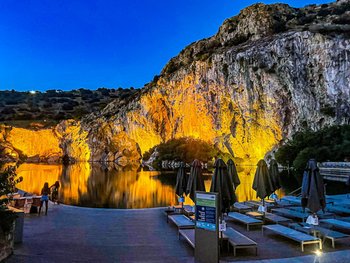
Situated in the heart of the luxurious Athenian Riviera, the lake is a unique karstic formation. The name "Vouliagmeni" itself stems directly from the Greek word for "sunken."
This is a precise description of the site’s morphology: a deep lagoon sheltered by majestic cliffs, formed when the roof of a giant cavern collapsed due to tectonic activity and the erosion of limestone rock.
Beneath the calm surface lies one of the most complex underwater cave systems in Europe. This labyrinth of tunnels stretches over 3,100 meters. Exploring these depths has shed new light on Greek history - researchers discovered prehistoric animal remains there, including lions, hippos, and even dwarf elephants, proving that thousands of years ago, the Attic landscape resembled today’s African savannah.
The Mystery of the "Curse of the Nymphs" and the Tragic History of Explorers
For centuries, the Vouliagmeni underground system has been shrouded in a dark aura of mystery. Even the ancient Greeks, staring into the black abyss of the cave, felt a deep sense of respect and fear. It was believed to be more than just a body of water—it was a gateway to the Underworld guarded by nymphs. These mythical beings were said to be exquisitely beautiful but merciless, jealously guarding the blue depths from mortal eyes.
Legend had it that anyone daring to disturb their peace would be pulled into a labyrinth from which there is no return.
From Ancient Myths to Urban Legends
In the 1960s and 70s, ancient beliefs resurfaced in a modern, terrifying form. Whispers of the "Vouliagmeni Curse" spread through Athens. The cause was the mysterious disappearance of young, fit men—often American divers from the nearby airbase—who overestimated their abilities.
Local residents told stories of luminous apparitions beneath the water's surface. They were said to lure divers into the narrowest underwater corridors, promising treasures or eternal youth. Those who succumbed to the seduction never surfaced again.
Why Are the Vouliagmeni Caves Closed? A Tragic Reality
The truth proved to be just as dark as the myths, though devoid of magic. The cave system beneath Lake Vouliagmeni is one of the most dangerous diving terrains in the world.
Why was this place so deadly?
-
Total Darkness: While the water is crystal clear at the entrance, it becomes murky deep inside due to sulfur deposits.
-
Strong Currents: Narrow tunnels act like nozzles, where sudden changes in pressure and current can immobilize a diver.
-
Tight Bottlenecks: Many corridors are only a few dozen centimeters wide - one mistake meant getting jammed in an inescapable trap.
The tragic toll stands at eight fatalities, with bodies recovered under extremely difficult conditions. These events were the direct cause of the government's 1995 decision to permanently close the caves to the public.
Today, as you relax on a luxury sunbed, the cave entrance - a black void beneath the limestone cliff - remains visible. Knowing that a three-kilometer labyrinth that claimed the lives of explorers stretches beneath your feet adds a metaphysical weight to the scenery.
Currently, scientists equipped with 3D technology monitor the area. Their work, documented in the series Underwonder, allows us to peer into the caves without risking our lives. Thanks to them, we know the only "monsters" inhabiting these depths are unique, blind species of marine fauna adapted to life in eternal darkness.
Healing Properties: Health from the Depths
Lake Vouliagmeni is a complete wellness ecosystem. Thanks to thermal springs, the water maintains a constant temperature of 22 - 29°C year-round. High mineral concentrations give these baths official medical treatment status.
What conditions does Vouliagmeni water help with?
-
Musculoskeletal System: Invaluable relief for back pain, sciatica, and arthritis. The water relaxes tissues and improves joint mobility.
-
Dermatology: Thanks to the sulfur content, the lake is an ideal sanctuary for those with psoriasis and eczema.
-
Mental Health: The presence of lithium (a natural mood stabilizer) helps reduce stress and insomnia.
-
Natural Fish Spa: The lake is home to a wild population of Garra Rufa fish. These "doctor fish" provide a gentle peeling, removing dead skin cells.
Expert Tip: Dr. Cleopatra Balé recommends a specific methodology: the first bath should last up to 20 minutes, with each subsequent session extended by 5 minutes every two days. This allows the body to optimally absorb minerals without taxing the circulatory system.
Gastronomy: A Journey of Flavors at abraOvata
The luxury experience is completed by abraOvata, led by Chef John Skotidas. The menu is a bold fusion of Greek tradition with Asian and Latin American influences.
Signature Dishes:
-
Tuna Yuzu Jalapeño: Fresh tuna in a vibrant citrus broth.
-
King Crab Paella: Served with aromatic mastic resin.
-
Athinaiki Salad: A modern take on the classic crab salad on a crispy rice bruschetta.
Note: If your goal is only the restaurant, you do not need to pay the lake entrance fee. Simply inform the staff at the entrance.

Tickets and Getting There (2026)
Ticket Prices and Reservations
The ticket price includes access to the lake, sunbeds (Main Deck area), and sanitary facilities.
| Category | Weekdays | Weekends & Holidays |
| Adults | 17 € | 19 € |
| Students / Children (6–12) | 14 € | 17 € |
| Children under 5 | Free | Free |
Pro Tip: During the high season (April–October), it is essential to reserve a sunbed via the Beach Booking app. For more privacy, choose the Privé Area or the luxury Cabanas.
How to get there from Athens?
-
Public Transport (Budget Option): Take the Red Metro Line (M2) to the terminus station Elliniko. From there, transfer to bus 122. Get off at the stop named "Limne" (the Greek word for lake), located right by the entrance. Travel time: approx. 60–70 min.
-
Car or Taxi (Fastest Option): Head south via the coastal road (Leoforos Poseidonos). This is one of Attica's most scenic routes, running along luxury marinas and bays. Travel time: 25–35 min. Bonus: The facility provides free parking for guests.
-
Organized Tours (All-in Option): Many travel agencies in Athens offer half-day trips to the lake. These are often combined with a coastal cruise or sunset viewing at Cape Sounion.
.png)

Etiquette and Nature Conservation (NATURA 2000)
The lake is strictly protected due to the endemic sea anemone Paranemonia vouliagmeniensis. Rigorous rules apply:
-
No UV Filters: It is strictly forbidden to enter the water with sunscreen on. You must rinse off in the showers (without detergents) before swimming.
-
Quiet Zone: The cliffs are nesting grounds for birds; guests are asked to keep noise levels down.
What to see nearby?
-
Faskomila Hill: Right behind the lake, offering trails with views of the Saronic Gulf.
-
Cape Sounion: A 30-minute drive further south brings you to the majestic Temple of Poseidon, perfect for sunset.
Lake Vouliagmeni is a rare example of a place that, despite its popularity, has not lost its character. It is the perfect stop between exploring ancient monuments and island hopping - a place that regenerates the body physically and feeds the imagination mentally.
FAQ - Lake Vouliagmeni
Is the water in Lake Vouliagmeni salty?
The water is brackish. It is a unique mixture of seawater seeping through the rocks and underground thermal springs. This results in high mineral content, but it is not as salty as the open sea.
Do I need water shoes?
Water shoes are not essential as access to the lake is usually via ladders or steps directly into deeper water. The lake floor in the swimming area is safe, but if you plan to walk on rocky shores outside the designated zone, protective footwear is useful.
Is the lake safe for children?
Yes, but constant supervision is required. The water is very buoyant due to minerals, making swimming easier. However, the lake is deep almost immediately from the edge, so non-swimming children must use armbands or vests. Lifeguards are on duty.
Can I go diving in Lake Vouliagmeni?
Recreational snorkeling is allowed and popular. However, scuba diving and entering the underwater caves are strictly prohibited and subject to heavy fines for safety and environmental reasons.
Can I visit the lake in winter?
Yes, Lake Vouliagmeni is open year-round. Thanks to the thermal springs, the water temperature never drops below 22°C, making swimming comfortable even in January or February.


