How to Use Public Transport in Athens in 2026: Tickets, Airport Travel & No-Stress Tips
- Tap2Ride Contactless Payments – Learn how to pay with your credit card or phone on all Athens buses and trains.
- 2026 Price Guide – Current fares for 90-minute tickets, daily passes, and multi-day tourist bundles.
- Airport to City Center – Essential details on Metro Line 3 and the 24/7 Express Buses (X95, X96).
- Smart Fare Capping – How the "Daily Cap" saves you money by limiting your total daily cost to €4.10.
- Discounts & Reduced Fares – Who qualifies for half-price tickets and what ID you need to show.
- X80 Tourist Express Line – The fastest way to get from Piraeus Port to the Acropolis and Syntagma Square.
For many travelers, the first challenge after landing in a new place is figuring out public transportation: where to buy a ticket, which one to choose, how to validate it, and whether it’s actually valid on the mode of transport you’re using. In Athens in 2026, that problem has practically disappeared.
The new public transport system was designed to be intuitive even for people visiting the city for the first time and not speaking Greek. The metro, buses, trolleybuses, trams, and suburban rail form one cohesive, logical network that’s easy to navigate. Thanks to reforms introduced in 2024–2025, Athens has become a city where using public transportation is simple and convenient. For tourists, that means less stress, more freedom, and the ability to focus on sightseeing instead of decoding complicated transit rules.
How do you get around Athens without paper tickets and ticket machines?
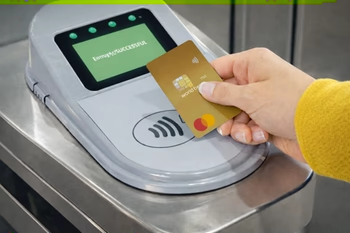
The most noticeable change for tourists is the introduction of the Tap2Ride system. Tap2Ride is the most modern way to pay for rides on buses, trolleybuses, the metro, and trams — you just use a regular payment card or its digital version on your phone or smartwatch (Apple Pay, Google Pay). Contactless bank card payments are available directly on validators across all public transport services operated by OASA. This means you don’t need to buy a ticket before your trip or figure out which fare option is right. To ride, all you need is:
- a payment card (debit, credit, or prepaid Visa/Mastercard) - Revolut works too
- or an NFC-enabled device, like a phone or smartwatch with contactless payments.
When entering the metro or boarding a bus, you simply tap your card or phone on the reader, and the system automatically registers your ride. There’s no need to print tickets, top up transit cards, or use ticket machines - which can be a hassle for tourists.
How does Tap2Ride work on Athens public transportation?
Tap2Ride runs in the background without requiring your attention. It counts your rides and automatically chooses the cheapest option. Each ride costs €1.20, but the system keeps track of how many trips you take. Once your total charges for the day reach €4.10, the system automatically stops charging you. From that point on, all additional rides that same day are free - no need to buy extra tickets or do anything else. In practice:
- If you use transit only occasionally, you pay only for individual rides.
- If you’re sightseeing a lot and traveling frequently, the system effectively “converts” your charges into an all-day pass.
For tourists, this is an exceptionally convenient solution because it eliminates the risk of overpaying and the need to analyze complicated fare tables. In high-traffic areas like Syntagma or Monastiraki, the long lines at ticket machines that used to be a daily sight have disappeared.
It’s worth remembering, however, that contactless card payments do not cover discounted tickets, such as student fares or other reduced-price rides. For the system to calculate your whole journey correctly, including transfers, you must use the same card or the same device the entire time. This applies both to entering and exiting the metro and to every time you board a bus, trolleybus, or tram. If you use a different card or phone during a transfer, the system will treat it as a new ride and charge you again.
Additionally, on the first contactless transaction of the day, Mastercard payment systems may temporarily charge a symbolic €0.01 as a verification step. This amount is automatically refunded during the final transaction settlement.
Is public transportation in Athens expensive and safe?
Public transportation in Athens is safe, modern, and affordable, making it one of the most convenient ways to get around for both tourists and residents. Solo travelers can also use public transit comfortably. The metro, trams, and suburban rail (Proastiakos) are considered the safest options. Stations are well-lit, monitored, and the trains are well-maintained - so evening travel generally isn’t an issue.
Buses and trolleybuses are also safe, though they can get very crowded during rush hour. In crowded conditions, it’s smart to take basic precautions because - like in other major European cities - petty pickpocketing can occur, especially downtown and near popular tourist attractions. Truly dangerous or aggressive incidents are rare.
Alongside the digitization of the ticketing system, Athens carried out a major modernization of its public transport fleet. More than a thousand new eco-friendly buses were added, and metro trains - especially on Lines 2 and 3 - were extensively refurbished. For passengers, this means better punctuality, improved air-conditioning, cleaner and quieter vehicles, and noticeably higher comfort.
Despite major investments, ticket prices have been kept at a reasonable level and remain competitive compared to other popular tourist cities in Europe. Thanks to that, Athens public transportation is not only safe and convenient, but also one of the most cost-effective ways to explore the city.
What does this mean for you as a tourist?
Public transportation in Athens in 2026 is increasingly designed around traveler comfort. Using it doesn’t require prior preparation or knowledge of local rules. To start your trip, all you need is a payment card or a phone with contactless payments, which lets you move freely across the city. The system automatically recognizes subsequent rides, calculates charges, and applies the most cost-effective daily fare. You don’t need to buy tickets, validate them, or track limits - everything happens in the background.
As a result, public transit becomes a convenient, intuitive part of sightseeing. It makes it easy to reach both the major landmarks and less-visited neighborhoods of Athens, offering a calm and hassle-free way to explore the city.
Which tickets should you choose as a tourist in Athens?
Although in 2026 more and more passengers in Athens pay with a bank card or phone, traditional tickets and cards are still available and widely used. They’re mainly used by people eligible for discounts, residents with long-term passes, and tourists who prefer classic solutions.
The Athens ticketing system is based on three types of physical media. They differ in durability, how they’re used, and which types of tickets can be stored on them.
ATH.ENA Ticket
The ATH.ENA Ticket is a paper ticket with a built-in microchip. Despite its traditional format, it functions as a modern electronic medium. It can be topped up multiple times and used across the entire Athens public transport network.
The ticket does not contain the owner’s personal data, so if it’s lost, stolen, or destroyed, it cannot be refunded or restored. If it has stored value, someone else could use it. In the event of a technical issue, the ticket can be replaced, and transfer rules are preserved - provided you can show proof of purchase or top-up.
This option is especially popular among tourists staying in Athens for a short time, people who don’t want to use Tap2Ride, and occasional riders who prefer a simple, single-ticket approach. The ATH.ENA Ticket can store:
- single-ride tickets,
- 24-hour tickets,
- short-term packages, e.g., 5-day passes.
Limitations: this ticket cannot store:
- long-term passes (longer than 5 days),
- discounted fares.
For most tourists visiting Athens for a few days, however, it’s fully sufficient and easy to use.
ATH.ENA Card: durable card with no personal data
For people who want a durable plastic card but don’t want to provide personal details, there is the anonymous ATH.ENA Card. It contains no user information and isn’t assigned to a specific person. Due to controlled distribution, it can only be purchased at ticket offices and is not available in machines. The anonymous ATH.ENA Card can store up to €50 of monetary value and works like an electronic wallet. The system automatically deducts fares for subsequent rides.
This option works particularly well for people staying in Athens longer who want one durable medium but don’t need personalized cards or discounted tickets.
Personalized ATH.ENA Card: long-term passes and discounts
The most advanced option is the personalized ATH.ENA Card, which includes the user’s name and photo. It’s assigned to a specific person and fare profile. This is the only medium that:
- supports monthly, quarterly, and annual passes,
- allows discounted fares (e.g., student or senior discounts),
- enables recovery of funds if the card is lost or stolen.
This is mainly used by Athens residents and people staying long-term who have an AMKA (Greek social security) number. For a typical tourist, it’s generally not feasible.
Which tickets should you choose as a tourist in Athens?
In practice:
- Tap2Ride is the simplest option for most visitors,
- ATH.ENA Ticket works well for a short stay and a classic ticket approach,
- ATH.ENA Card makes sense mainly for longer stays or using discounts.
Athens public transport ticket prices (city zone)
In 2026, ticket prices in the city zone, covering Athens, Piraeus, and the surrounding suburbs (excluding airport connections), remain unchanged. This reflects a government policy of subsidizing public transport to reduce the impact of inflation and keep transit accessible for residents and tourists.
Single-ride and time-based tickets
A standard 90-minute ticket in Athens costs €1.20 and allows unlimited transfers between all public transport modes in the city zone, such as the metro, trams, buses, trolleybuses, and suburban rail. This is the most commonly chosen option, making it easy to get around the city, supporting integrated intermodal trips, and letting you plan trips conveniently without buying additional tickets.
| City product type | Regular price | Discounted price | Validity / Notes |
|---|---|---|---|
| 90-minute ticket | €1.20 | €0.50 | All modes (excluding airport) |
| 24-hour ticket (day pass) | €4.10 | No discount | Unlimited rides |
| 5-day ticket | €8.20 | No discount | 5 full days (120 hrs) |
| Bundle: 2 × 90-minute tickets | €2.30 | €1.00 | Save €0.10 on the bundle |
| Bundle: 5 × 90-minute tickets | €5.70 | €2.50 | Save €0.30 on the bundle |
| Bundle: 10 + 1 FREE | €12.00 | €5.00 | One ticket free with ten |
The 5-day ticket is not valid on the X80 express line or on airport connections. For that reason, it’s mainly intended for people traveling regularly within the metro area, such as tourists planning intensive sightseeing or business travelers who want to reduce the cost of daily public transport rides.
Getting to the Athens airport - special tickets, prices, and transport options
In 2026, getting to Athens International Airport (AIA) is possible via three main modes of transportation. Each offers different prices, travel times, and comfort levels, so it’s easy to match an option to your pace of travel and budget.
1. Metro: Line 3 (Blue)
The metro remains the fastest and most reliable way to get between the airport and Syntagma Square, taking about 40 minutes. Trains run every 30 minutes, from early morning (around 6:30 a.m.) until late at night (around 11:30 p.m.).
| Airport product – Metro | Regular price | Discounted price | Details |
|---|---|---|---|
| Single ticket (90 min) | €9.00 | €4.50 | Includes transfers in the city |
| Return ticket | €16.00 | No discount | Valid for 30 days from first validation |
| AIA – Pallini/Koropi segment | €5.50 | €2.70 | Fare for intermediate stations |
The airport metro ticket in Athens is an integrated ticket. After validating it at the airport, you can continue your journey within 90 minutes using any OASA transport, such as the metro, bus, tram, or trolleybus. This is especially important for travelers whose final destination is outside the strict city center, because it allows you to transfer and reach more distant neighborhoods efficiently at no extra cost.
2. Express buses (X93, X95, X96, X97)
Express buses are the backbone of cheap and late-night airport transport in Athens because they run 24/7. Route X95 takes passengers directly to Syntagma Square in the city center, X96 goes to the port of Piraeus (great for ferry connections), X93 connects the airport with Kifissos bus station, and X97 ends at Elliniko metro station, where it’s easy to continue around Athens.
| Express bus parameter | Price and key info |
|---|---|
| Regular fare | €5.50 |
| Discounted fare | €2.70 |
| Validity | One direct ride only |
| Where to buy | Airport kiosk, machines, Tap2Ride |
| Typical travel time | 60–90 minutes depending on traffic |
In 2026, Tap2Ride on express buses became very popular, accounting for about 15–20% of all transactions. It’s the result of convenience and simplicity, passengers boarding at the airport just tap their payment card on the reader by the doors, without searching for a ticket office or machine.
3. Suburban rail (Proastiakos)
Proastiakos offers an alternative connection from the airport to Athens’ main railway station (Larissis Station) and directly to Piraeus, without needing to transfer to the metro. The airport-segment fare is aligned with the metro fare (€9.00), but note that tickets purchased at Hellenic Train ticket offices may have a different physical format than OASA machine tickets.
Tourist Ticket (3-Day Tourist Ticket)
The Tourist Ticket (3-Day Tourist Ticket) is, in 2026, one of the best options for short visits to Athens. For €20.00, you get a complete bundle of rides that would be noticeably more expensive and less convenient if purchased as single tickets.
What does the tourist ticket include?
-
Airport transport round-trip - a full ride by metro or express bus. With standard metro pricing (about €16 round-trip), that means the remaining city transit for 3 days effectively costs only €4.
-
72 hours of unlimited rides on all transport modes in the city zone, counted from first validation.
-
Access to route X80, which does not accept standard 90-minute tickets and is especially useful for tourists.
-
Easy availability - you can buy it from machines at the airport, in the port of Piraeus, and at major metro stations such as Syntagma, Omonia, and Monastiraki.
This option is especially recommended for cruise passengers and people planning intensive sightseeing along the Acropolis – Athens center – Piraeus route, because it covers all the key transport needs of a typical tourist stay without worrying about extra tickets.

Express route X80: Piraeus – Acropolis – Syntagma
Express route X80: Piraeus - Acropolis - Syntagma is one of the most “tourist-friendly” parts of Athens public transportation. It provides a fast and convenient connection from the port of Piraeus to Athens’ historic center, skipping many local stops. The route runs seasonally - from May to October, which aligns with peak cruise traffic in the Aegean Sea.
How does route X80 work in practice?
In 2026, route X80 is not covered by the standard single-ride ticket. The goal is to reduce overcrowding and improve comfort, especially for tourists.
Accepted fare options:
-
24-hour ticket (€4.10),
-
3-day tourist ticket (€20.00),
-
Tap2Ride - card payment, with a daily cap applied.
Route and stops:
The bus stops at 16 key stops, including the Acropolis Museum, the Archaeological Museum of Piraeus, the Stavros Niarchos Foundation Cultural Center, and the Planetarium, making it a great option for sightseeing.
Frequency:
Buses run every 35–40 minutes, between 7:00 a.m. and 9:15 p.m..
Transfers:
Easy connections to Metro Lines 1, 2, and 3 are available at Syggrou-Fix, Neo Faliro, and Syntagma.
For passengers arriving by ferry, route X80 is a much more convenient alternative than the 24/7 040 line. While 040 is cheaper (€1.20), it stops frequently and can get very crowded, especially in summer.
Discounts and free rides in Athens: who qualifies and what documents are required
In 2026, the public transport system in Athens offers a wide range of discounts and free rides, especially for children, teens, seniors, and selected social groups. However, keep in mind that every discount must be properly documented — if you don’t have the required document during an inspection, you may receive a hefty fine, even if you actually qualify.
Who qualifies for reduced fares?
The discount is usually around 50% off the standard fare (e.g., €0.50 instead of €1.20 for a 90-minute ticket).
-
Children and teens (ages 7–18) - regardless of nationality. A passport or national ID is sufficient.
-
Seniors (65+) - also regardless of nationality. A passport or national ID is required.
-
Students:
-
students of Greek public universities (including ERASMUS) - based on the digital Academic ID marked “ΔΕΛΤΙΟ ΕΙΣΙΤΗΡΙΟΥ”,
-
foreign students outside Greece up to age 24 - must present their university student ID and passport to issue a personalized ATH.ENA card.
-
Important: the ISIC card is not accepted as a stand-alone basis for discounts on Athens public transit.
-
Who can ride for free?
-
Children under 6 ride free with an adult, no ticket required.
-
People with disabilities - applies to Attica residents with the proper certification.
-
Unemployed people - Greek citizens registered with OAED, with a valid unemployment card.
How do you use a discount in practice?
Most discounts require a personalized ATH.ENA Card to store reduced-fare tickets. An exception is tickets purchased at suburban rail (Proastiakos) ticket offices - there, the discount can sometimes be applied directly on the ticket after showing documents. For a tourist senior or tourist student, this means it’s worth going to an ATH.ENA card issuing point right after arriving, e.g. at Syntagma station or at the airport, to use discounts smoothly during your stay.
So what should you choose?
If you’re in Athens for 2–3 days, the most convenient choice is the 3-day Tourist Ticket, which includes both city rides and airport transport. If you’re doing intensive sightseeing and moving around frequently, the best option is Tap2Ride — the system automatically applies the best daily fare without you having to analyze ticket types. If you use transit occasionally or prefer traditional solutions, the simple and clear option is still the ATH.ENA Ticket. For late-night or very early flights, the most reliable choice is the X95, X96, X93, or X97 express buses, which run 24/7. In summer, between Piraeus and downtown, the X80 route is exceptionally convenient.
Most importantly, Athens’ transit system in 2026 is flexible and tourist-friendly. You can freely mix different ways of paying and change how you travel during your stay - without stress or surprise costs. In practice, that means you don’t have to plan everything in advance - a payment card or phone is enough to move around the city with ease. It’s worth saving this guide or coming back to it after you land, so public transportation becomes a natural and convenient part of exploring Athens.