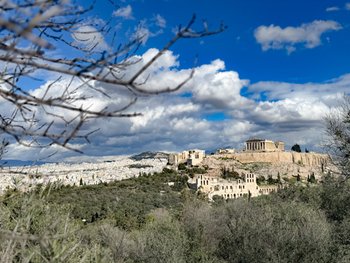
Athens for Free: Where to Find the Best Acropolis View? Discover Philopappos Hill
While the Acropolis dominates the skyline of the Greek capital, it is from Philopappos Hill (the mythical Hill of the Muses) that the most spectacular view imaginable unfolds. While thousands of tourists crowd the marble steps of the Parthenon, just a few hundred yards away lies an oasis of tranquility where ancient history harmoniously intertwines with wild Mediterranean nature.
Philopappos Hill is not just a free alternative to paid observation decks; it is, above all, a journey through time - a place free from commercial noise that captures the true spirit of ancient Athens. Here, in the shade of century-old pine and olive trees, you will discover the secrets of royal monuments and ancient districts that have shaped the soul of this city for centuries. If you are looking for the perfect sunset spot or want to feel the magic of Greece without the rush, the Hill of the Muses is a mandatory stop on your map.

UNESCO Heritage and the Vision of Dimitris Pikionis
Philopappos Hill is much more than just a viewpoint; it is a vast, history-steeped archaeological park of immense significance, inscribed on the UNESCO World Heritage list. Walking along the paths here, we aren't just moving on ordinary sidewalks, but on a unique work of engineering and landscape art. These paths were designed between 1954 and 1958 by the eminent Greek architect Dimitris Pikionis, who aimed to create a dialogue between modern man and the ancient spirit of Athens.
- Harmonious Integration with Nature: Pikionis created a system of paths that emerge almost organically from the terrain, harmoniously blending the raw, natural landscape with ancient ruins.
- Materials with a Soul: Traditional craftsmanship and materials salvaged from the demolition of 19th-century Athenian buildings were used to construct the paths, giving them a unique texture and color.
- A Stone Mosaic Beneath Your Feet: Every yard of the path is a carefully laid, hand-finished mosaic of stones, ceramics, and marble fragments. Its purpose is to guide the viewer through history unobtrusively, ensuring that the architecture never distracts from the majesty of the surrounding nature. Pikionis didn't just use recycled materials; he personally supervised the placement of every fragment, creating abstract compositions inspired by the geometry of ancient vases. This makes the Philopappos path one of the most significant examples of critical regionalism in the world.
- The Path as a Spiritual Experience: Pikionis's project is considered one of the most important achievements of modern landscape architecture, as it transforms a simple uphill climb into a deep, almost meditative journey toward the summit of civilization.
The Monument of Philopappos: A Symbol of Royal Splendor
The main landmark and destination of the hike is the monumental tomb erected at the very summit (482 ft above sea level) between 114 and 116 AD.
- Who was Philopappos?: The monument commemorates Gaius Julius Antiochus Epiphanes Philopappos, a prince from the Syrian Kingdom of Commagene and a Roman consul, who was regarded as a great benefactor of Athens.
- Pentelic Marble Craftsmanship: The 40-foot-high structure was crafted from precious Pentelic marble, quarried from Mount Pentelicus—the same material used to build the Parthenon.
- Facade Architecture: The monument features a curved facade with three deep niches. A statue of Philopappos himself sits in the central part, with his grandfather King Antiochus IV on the left, and King Seleucus I Nicator on the right (the latter statue is now lost).
- Mythical Past: Before the hill took its current name, it was dedicated to the Muses. Legend has it that Musaeus, the mythical disciple of Orpheus, lived and was buried here


Historical Treasures Hidden in the Greenery - What to Visit?
Philopappos Hill is a labyrinth of picturesque paths that hide fascinating archaeological sites:
- Church of Agios Dimitrios Loumbardiaris: At the foot of the hill, in the shade of ancient pines, you will find this 15th-century Byzantine chapel dedicated to Saint Demetrius, which is one of the most atmospheric places in all of Athens. Its name, Loumbardiaris, is tied to a fascinating local legend about the building's miraculous escape from a cannon blast (the loumbarda) in the 17th century, a story that still draws history buffs and folklore enthusiasts today. It is worth stepping inside not only for the breathtaking frescoes but, above all, for the unique interior decor and exquisite wooden finishes. These were carefully designed by Dimitris Pikionis so that the raw, ancient materials would harmonize with the spiritual atmosphere and unobtrusively lead the viewer through the layers of time.

- Prison of Socrates: These are among the most mysterious rooms, carved directly into the hard limestone, which according to local tradition served as the cell for the famous philosopher before his execution. While archaeologists debate their original purpose, this site hides another secret from modern times. During World War II, the most precious treasures from the National Archaeological Museum, including the famous Mask of Agamemnon, were hidden in these rock chambers behind thick concrete walls to protect them from looting.
- Mysticism and Facts: Although modern archaeology suggests these are remnants of a luxury home from the Classical period or a monumental Roman tomb, the raw form of these caves does not diminish their mystical aura and historical weight.
- Sanctuary of the Muses and Nymphs: As you traverse the slopes, you will encounter numerous niches, altars, and water cisterns carved into the rock, bearing witness to the ancient cult of deities protecting art, science, and nature.
- Echoes of Ancient Worship: These spots, rarely visited by mass tourists, allow you to feel the genuine connection ancient Athenians had with the deities believed to inhabit these sacred groves.
Logistics and Transit: Where to Park Near Philopappos Hill?
When planning a visit to the heart of Athens, keep in mind that the best and most stress-free way to reach the Hill of the Muses is via the metro. The Greek capital has a modern subway system that helps you avoid traffic jams and parking headaches. The closest stations are Sygrou-Fix (Red Line M2) or Akropoli (Red Line M2) -from both, it’s just a short, 15-minute walk through the charming Koukaki district or along the scenic Dionissiou Areopagitou promenade.
However, if you are traveling around Greece in a rental car or your own vehicle, be prepared for the fact that central Athens can be a logistical challenge. Narrow streets and restricted traffic zones require advanced planning.
|
Parking Type |
Location and Benefits |
|
Rovertou Galli Street |
Street parking right at the park entrance. The closest option, but it requires a lot of luck to find a spot. |
|
Sygrou–Fix Metro Parking |
A large, modern underground parking garage. This is the safest and most convenient option in this part of town. |
|
V1935 Parking (Koukaki) |
A private garage in the atmospheric Koukaki neighborhood, ideal for those planning dinner at a local tavern after their walk. |
Nature at Your Fingertips: Tortoises, Owls, and the Green Lungs of Athens
The Hill of the Muses is more than just ancient stones and monumental tributes; it is a vibrant, self-sustaining ecosystem that serves as one of the most critical ecological corridors in the heart of concrete Athens. Walking these paths, you will quickly forget that you are in a metropolis of millions.
-
Meeting the Ancient Residents - Land Tortoises: Strolling early in the morning or just before sunset, you are almost guaranteed to encounter wild land tortoises (mainly the Greek tortoise species) slowly crossing the stone paths in the lower part of the hill, especially near the Koile Valley [cite: 2026-01-26]. These fascinating reptiles are a symbol of the area's serenity and a favorite highlight for younger travelers.
-
Rulers of the Night - Athenian Owls: If you stay quiet as the sun dips below the horizon, you may hear the distinctive calls of tawny owls. For these birds, the ancient pines, oaks, and numerous rocky crevices provide a natural home and hunting ground right in the city center.
-
Flora Scented with History: The vegetation on the hill is the quintessence of the Mediterranean landscape. You will catch the heavy scent of resinous pines, wild thyme, and sage clinging to the rocky slopes. In the spring, the hill is covered in a carpet of wildflowers, including rare orchid species, drawing botany enthusiasts from around the globe.
-
A Green Haven for Migratory Birds: Thanks to its location and lush vegetation, Philopappou is a vital stopover for migratory birds. It is a true paradise for birdwatchers, who can spot species rarely seen in other parts of mainland Greece.
-
An Ecological Community: The presence of such rich fauna and flora next to the Acropolis is a testament to how effectively the wild character of this site has been preserved despite the capital’s ongoing urbanization.
Discover More: The Secrets of the Koile Valley and the Diateichisma Walls
If you want to experience Athens through the eyes of a history buff, head toward the Koile Valley. There, you will find an ancient "highway" up to 40 feet wide, featuring wagon wheel ruts etched into the stone, along with the massive Diateichisma defensive walls that protected the city for centuries.
Practical Visit Summary:
-
Admission: $0 - one of the best free attractions in Athens.
-
Visiting Time: Plan for at least 1.5 to 2 hours, especially if you are aiming for sunset.
-
Best For: Photographers, families, and anyone seeking peace in the shade of Athenian pines.
An Athens You Won’t Forget
Philopappos Hill is one of those rare places where time seems to slow down, and the majesty of antiquity isn't overwhelmed by guardrails and crowds with cameras. Whether you are looking for the perfect Instagram shot or a moment of meditation on the history of civilization, the Hill of the Muses provides memories that money can't buy. As the sun begins to set behind the Saronic Gulf and the Parthenon lights up with its first evening illumination, you will realize why the real heart of the Greek capital beats here, and not on the marble steps of the Acropolis.
Pack comfortable shoes, grab a bottle of water, and give yourself time to get lost in the labyrinth of Pikionis’s paths. Athens has much more to offer than the popular brochures suggest - and Philopappos Hill is the ultimate proof.